
Service area

Roofing in Cathedral City.

In the western valley’s blowsand corridor, where wind, sand deposits and strong sun make roof surfaces, fastening and drainage inspection priorities.

Illustrative view over dense single-storey roofs, palms bending in the wind, Mount San Jacinto and the haze of the pass behind
Cathedral City, illustrated. Not a photograph of our work.
The whole service area, with Cathedral City marked. The pins are city centres. No job, photograph or date is marked on this map.

West valley, directly downwind of the gap between the San Bernardino and San Jacinto ranges.

Elevation
330 ft above sea level
Incorporated
November 16, 1981
Population
51,493 2020 census
Area
22.75 sq mi
ZIP code
92234
Energy code
California climate zone 15

Elevation, incorporation, census and area are public record. The climate zone is read from the California Energy Commission's own list of building climate zones by ZIP code.

Conditions

Roof exposure in Cathedral City.

  • 01

    The blowsand corridor runs straight through it

    The USGS describes wind-blown sand moving east from the San Gorgonio Pass toward Indio, most actively from April through June. Cathedral City lies along that western-valley corridor. Inspect exposed surfaces for wear and drainage outlets for deposited sand. The presence of grit alone does not establish a roof failure; it needs to be assessed with material condition and the other findings on the roof.

  • 02

    The wind that carries it

    The mountain pass exposes the western valley to wind that can carry dust and sand. Roof perimeters, rakes, eaves and exposed metal deserve close inspection, together with tile fastening and ridge details. A repair proposal should identify the damaged connection and its surrounding assembly. Current site-specific wind requirements should guide the work rather than assumptions based only on the neighborhood name.

  • 03

    Heat and connections between materials

    The cited record includes a high of 122 °F and about 4.85 inches of annual rain. Repeated heating and cooling moves roof materials and stresses their connections. Check flashings, penetrations and laps as well as the broad surface. An inspection should identify which material or connection needs work rather than attributing every stain or crack to heat alone.

  • 04

    Establish the project wind requirements

    Cathedral City is not named on the county’s July 2021 special wind region list, although neighboring Palm Springs, Rancho Mirage and Thousand Palms are. The handout identifies the list as non-exhaustive. Its omission cannot establish the design for an individual property. Confirm current site criteria before choosing roof fastening and perimeter details, including any requirements that differ from nearby properties.

The roofs here

The roof assemblies behind Cathedral City’s buildings.

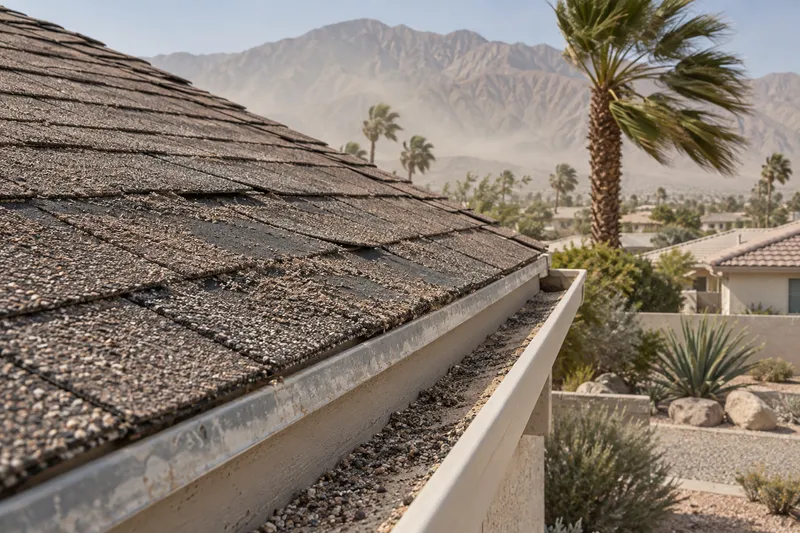
Illustrative close view of a worn composition shingle edge and a gutter holding sand and loose granules, a palm bending in the wind beyond
Illustration of the roofs described here, not a job of ours.

Roof histories after the 1980s expansion

Cathedral City grew from about 4,130 residents in 1980 to more than 30,000 in 1990. Properties from that period may now have replacement roofing, original components or a mix of repaired assemblies. Establish the roof history and condition rather than assuming the covering is original. Decking, underlayment and flashing observations help distinguish localized work from a full replacement.

Older than its incorporation date suggests

Cathedral City incorporated in 1981, but subdivision began in 1925. Older neighborhoods therefore contain buildings that predate the major growth period by decades. Roof coverings, additions and previous repairs may use different materials on the same property. Check those transitions and the existing layers before defining the work; the incorporation date does not describe the age or condition of an individual roof.

Access and neighboring properties

The 2020 census counted more than 51,000 residents across under 23 square miles. On smaller residential lots, access, material staging and roof removal need a property-specific plan. Discuss side yards, driveways, neighboring structures and daily cleanup before work begins. Those practical details belong alongside the proposed roof system, materials, timeline and cost in the written scope.

Local building patterns help guide an inspection. Your roof’s actual condition, materials and repair history determine the recommendation.

Code and permits

Roofing codes and permits in Cathedral City.

Confirm the requirements for the building and proposed roof assembly. The links below go directly to the relevant authorities.

Climate zone 15

92234 falls in California building climate zone 15. Climate zone, building type and roof slope help determine the energy requirements for a proposed roof. California’s climate-zone rules do not apply to our Arizona service region.

The CEC's climate zone list

Cool roof requirements

California’s 2025 Energy Code took effect January 1, 2026. Cool-roof requirements vary by building type, climate zone, roof slope and project scope. Check the applicable path and the product’s CRRC rating before choosing a roof surface.

A single reflectance or SRI threshold does not apply to every roof. Confirm the current requirements and any exceptions with the building department.

Title 24 at the Cool Roof Rating Council

Wind

Cathedral City is not itself named on the county’s special wind region list, though Palm Springs, Rancho Mirage and Thousand Palms around it are and the list is explicitly not exhaustive. The county's July 2021 handout gives 100 mph for Risk Category II, Exposure C outside a special wind region and 130 mph inside one, and directs designers to ATC Hazards by Location for the individual site. Wind load rises with the square of the speed, so the difference between those two numbers is about 69 per cent more load, which is why it is worth establishing rather than assuming.

The county's design load handout (PDF)

The county wind handout cited here is revision 07/2021, based on the 2019 California Building Code and ASCE 7-16. Its figures explain the cited document; they are not a current site-specific design calculation. Confirm the governing code edition and design criteria with the building department.

Free written estimate

Know what your
roof needs.

Free written estimate. No obligation.

Prefer to talk? Call us.

(442) 637-5222

Coachella Valley, California & Greater Phoenix, Arizona.
A 50-mile Phoenix radius, including Buckeye.

Add roof details (optional)

Your details prepare an email request for you to send. Nothing is sent automatically.

License & written terms

Verify California CSLB #1155461

Ask for insurance documentation and applicable warranty and maintenance options in writing before work begins.